Proportional Representation Society
of Australia
Proportional Representation Society
of Australia |
| |
| Victoria-Tasmania
Branch |
| |
| Hare-Clark Proportional
Representation Analysis of Victorian Legislative Council Periodic Polls
2002 |
| |
| Click on underlined subject below
to view it: |
| |
| Details of Votes & Seats in each of 2 Hare-Clark
Multi-member Provinces versus the Existing 22 Single-vacancy Provinces |
| |
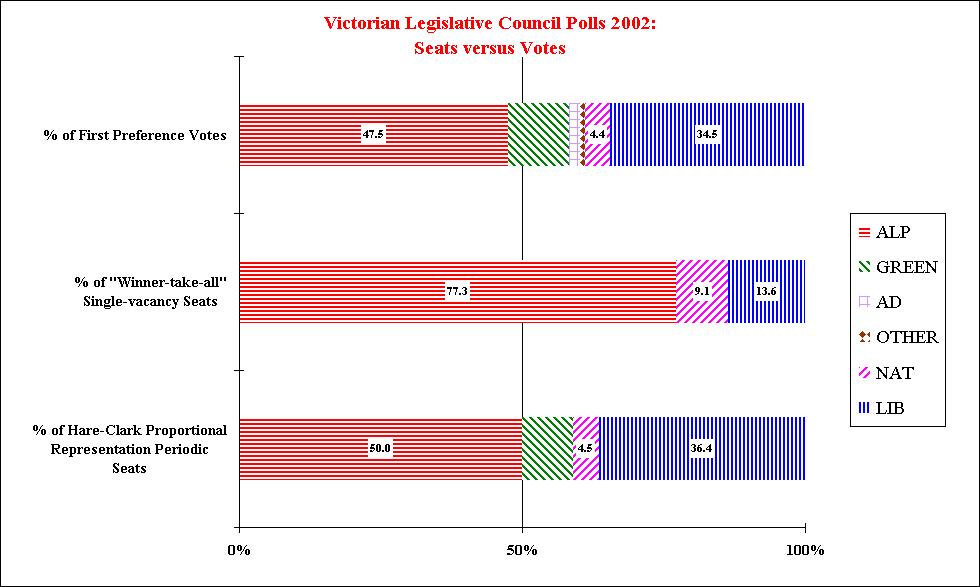
| Graph of Seats versus Votes Overall,
for Existing 'Winner-take-all' Single-vacancy Provinces & for Hare-Clark
PR Provinces |
| |
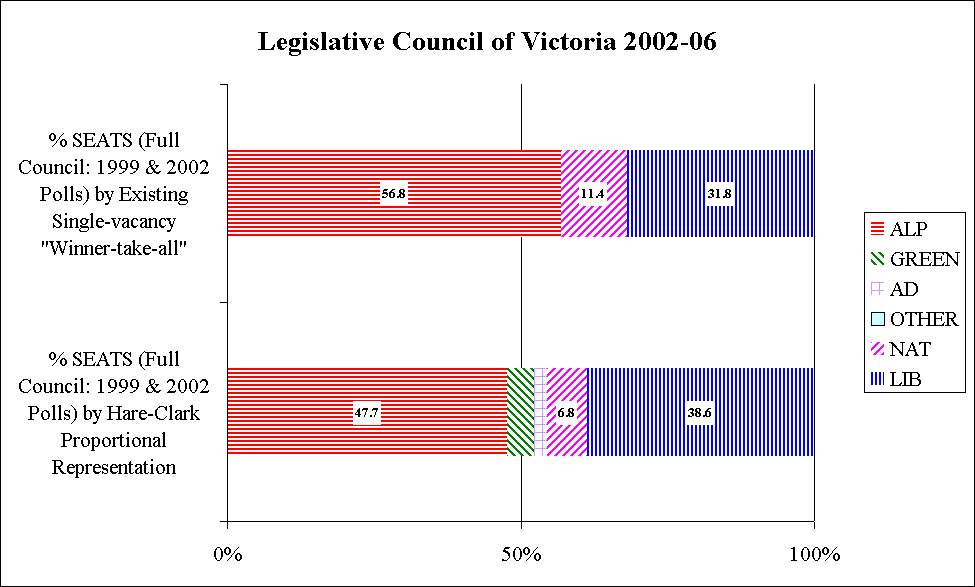
| Graph of Seats for the
Full Legislative Council (1999 & 2002 Components), for Existing "Winner-take-all"
Single-vacancy Provinces & for Hare-Clark PR Provinces |
| |
| The 1999 and 2002
polls for the Legislative Council, which have now become the last Legislative
Council polls to have been held under the "Winner-take-all" single-vacancy
system that had persisted, in various forms, since the Legislative Council
was established in 1855, resulted in the ALP holding an absolute majority
of seats on the floor of the Legislative Council as well as an ALP MLC
being assured of election as the President of the Legislative Council.
That majority, together with an absolute majority in the Legislative Assembly,
allowed the ALP Government to alter Victoria's Constitution Act 1975,
to implement the Government's announced intention that Legislative
Council polls will henceforth be held as general, rather than periodic
elections, under a quota-preferential system of proportional representation
in 8 multi-member electoral regions each electing 5 MLCs. |
| |
| Had the 1999 and
2002 polls been held by Hare-Clark proportional representation instead,
initiatives by the ALP, under an ALP President, could also have received
an absolute majority of votes of all MLCs, and thus allow an amendment
to Victoria's Constitution Act 1975, provided that at least three
other MLCs voted with the ALP. The non-ALP MLCs could not have achieved
any amendment to that Act, without the support of at least one ALP MLC.
Also it is notable that there would have been fewer ALP and more Liberal
MLCs if proportional representation, which the Liberal MLCs in the preceding
parliaments had always rejected, had applied. |
| |
| The Liberals received
almost a million first preference votes, but won only 3 of the 22 vacant
seats (333,319 votes per seat won). The ALP polled less than 38% above
the Liberal vote, yet it won 17 seats (80,913 votes per seat won), which
is 467% more seats than the Liberals gained. The Nationals, as is often
the case, needed the fewest votes per seat, as their vote, which was only
12.6% of that of the Liberals, gave them 2 seats (63,210 votes per seat
won), which was 67% of the 3 seats the Liberals won. |
| |
| It should be noted
that the National Party's first preference vote could be expected to be
larger under a Hare-Clark system where it would have its candidates able
to attract votes over a wider area. It presently gets zero votes in many
partly rural areas because it does not stand candidates there, owing to
its not having a strong enough presence to gain a majority of votes. With
the target in those areas being changed to the more voter-empowering quota
concept, they should start increasing their total vote once PR is introduced. |