|
QUOTA
QN2020B June 2020 www.prsa.org.au
SA
municipalities spared a reversion to South
Australia’s idiosyncratic bottoms-up
counting As was
reported in QN2019D, the
South Australian Branch of the Proportional
Representation Society of Australia made a
strong written submission to
the South Australian Government opposing the
proposal by the then Local Government
Minister, Hon. Stephan Knoll MLA, to revert to
South Australia’s earlier ‘bottoms-up’ method
of counting votes. Fortunately,
the Government did not proceed with that
proposal, so PR-STV will
remain the prescribed method for counting
votes at municipal elections. Mr Knoll later
resigned as a minister, on a separate matter
related to his claims for
travel expenses. Tasmania’s House
of Assembly Restoration Bill Tasmania’s
House of Assembly in 2018 established a
six-member all-party Select Committee
comprising two members from each of the
House’s three parties. It was chaired by the
Greens Party leader, Cassy O’Connor MHA;
included the Liberal Speaker, Hon. Sue Hickey
MHA; and was to consider and
report on the House of Assembly
Restoration Bill 2018. The 136-page Final Report of
the Assembly's all-party Select Committee on
the House of Assembly
Restoration Bill 2018 was
tabled in the Assembly in early 2020. The
Bill would reverse the Rundle Liberal
Government's 1998
reduction in
the size of both houses, which followed the
Groom Liberal Government's failed attempt to
revert to the earlier six MHA's per division
in 1993. The Final Report recommended,
with no dissenting report, that the Parliament
should pass the Bill, and that it should
establish in this term of Parliament, a
Joint Parliamentary Inquiry to develop a
preferred model that would provide for
dedicated seats for Tasmanian Aboriginal
people in the Parliament. Victorian
Governor’s termination of her Local
Government Minister’s commission The week beginning 14 June 2020
featured an investigative report by The Age
newspaper and Channel 9 television that shocked many
viewers when it showed videos of Victoria’s
then Local Government Minister, Adem
Somyurek MLC, appearing to engage crudely in
‘branch stacking’. That corrupt practice is the
signing up of uninformed and uninterested
people as members of a branch of a political
party on the basis that the membership fee
would be paid for them, and that the only
demand on their time would be to assist the
stacker by voting, when asked, for candidates
for pre-selection to winnable seats as
directed by the stacker. The branch-stacker can thus gain
personal control over the parliamentary voting
pattern of many of his or her party’s elected
MPs, which can give such a person great power
to determine outcomes with very little
democratic basis, particularly when it has
been ‘done on an industrial scale’ as critics
note. Victoria’s ALP Premier, Hon.
Daniel Andrews MLA, was quick to advise the Governor, Hon.
Linda Dessau AC, to terminate Mr Somyurek’s
commission as Minister, which she promptly
did. Soon afterwards, Hon. Marlene Kairouz MLA, who
had been Mr Somyurek’s predecessor as
Minister for Local Government - from 2017 to
2018 - and was reported to have assisted Mr
Somyurek in his branch stacking; and the
Assistant Treasurer, Hon. Robin Scott MLA,
each resigned their commissions. Mr Somyurek soon ceased to be a
member of the Australian Labor Party. He is
now an Independent MLC for South-East
Metropolitan Region. He was one of the two
Labor MLCs elected at the 2018 general
election, but neither is now sitting as a
Labor MLC, as the other member, Hon.
Gavin Jennings,
resigned from the Parliament in March 2020. Mr Jennings was replaced by a joint sitting of the
Parliament appointing in his place Mr Lee
Tarlamis, who had not been a candidate at
the 2018 general election. Mr Tarlamis thus
became the third unelected MLC in the
2018-22 term of Victoria’s Parliament. He is
now Chair of the Parliament’s Joint Standing
Committee on Electoral Matters. One of Mr Somyurek’s earlier
pre-ministerial roles in the Victorian
Parliament was as the Chairman of its
Electoral Matters Committee. PRSAV-T Inc. made
a submission to,
and appeared before, that
Committee’s 2007 Inquiry into the Conduct of
the 2006 Election under his chairmanship. Robin Scott MLA sat as an ALP
member of that Committee for that Inquiry, and
was quoted at Page 139 of the Committee’s Report
defending its decision not to recommend the
abolition of Group Voting Tickets, which
PRSAV-T Inc. had advocated in its appearance
before that Committee, and is still
advocating to the
current 2020 Committee. PRSAV-T Inc. wrote to the Premier
and the new Minister, Hon. Shaun Leane MLC,
asking that the reversions to
single-councillor wards Mr Somyurek had
announced be reversed, but Mr Leane later
initiated Orders-in-Council that
confirmed that the reversions would proceed.
Press articles
reported similar calls from Geelong, and
from peak municipal organizations, and
mayors of two affected councils. PRSAV-T Inc. will monitor and
report on the outcome of forthcoming elections
for those Councils where the recommendations
of the Victorian Electoral Commission for
multi-councillor wards to remain, or to be
introduced, were set aside by the above
Orders-in-Council instigated by the Minister. Taiwan’s
unicameral parliament election 2020
Taiwan’s general election on 11
January 2020 filled all 113 seats in its
unicameral parliament. There were 73 seats
elected from single-member electoral
districts using plurality
counting, 34 elected by parallel
voting using
a nation-wide closed party-list count, and 6
elected by the single non-transferable
vote from
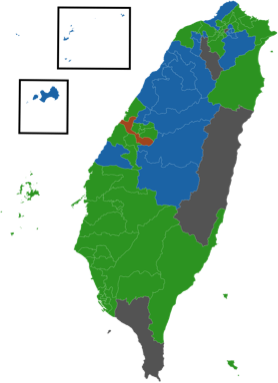
two 3-member electoral districts. The two largest parties’ areas
where they won their preponderance of
single-member seats are shown above as green for the winning centre-left
Democratic Progressive Party, and dark blue for the centre-right Kuomintang
(Nationalist) Party, which formed the
Opposition.
Table 1: Overall results of
Taiwan’s 2020 elections As Table 1 shows, the two largest
parties each won 13 seats in the party list vote
with the whole nation as one district,
although the largest single party, the
centre-left Democratic Progressive Party
(DPP), won a larger percentage of that party
list vote. Right wing candidates won none of
the other 8 party list seats. The number of winner-take-all
single-member seats was more than twice the
number of party list seats, so the slightly
greater number of DPP votes in those seats
artificially magnified its support enough to
give it an absolute majority of seats in
Parliament, and did not foil the party
list’s pointer of a lean to centre-left. Taiwan’s
second-largest party, the Kuomintang, once
ruled all of the then Republic of China,
including Taiwan, until that republic’s
Nationalist (Kuomintang) government lost the
1949 civil war. That war ended with the
Chinese Communist Party, then led by Chairman
Mao Zedong, ruling mainland China, which it
declared to be the People’s Republic of China,
in its present status as a single-party state.
Until
multi-party democracy was achieved in Taiwan
in the late 1980s, the Nationalists ruled, as
a single-party state, the only part of the
Republic of China that they had managed to
hold, which was the small archipelago
dominated by its main island of Taiwan. That
island is about half the area of Tasmania, but
has almost as many people as Australia. South
Korean National Assembly election 2020
On 15 April 2020, during its
shutdown for the COVID-19 pandemic, South
Korea held a general election for
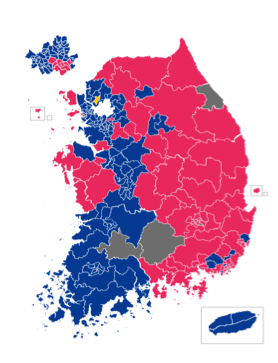
its unicameral National Assembly. Most of the
candidates elected were from the Democratic
Party of the President, Moon Jae-in.
Table 1: The 253 single-member
plurality seats Once the smaller number of the 47
remaining seats - whose results are shown in
Table 2 below, and which are determined by one
of two indirect
closed party list proportional
representation methods - is taken into
account, the victory is very much smaller.
Table 2: The 47 party list
seats As Table 2 shows, there were two
different closed party list systems used to
count the 47 party list seats. Most of them
are counted as in Mixed Member Proportional
(MMP) systems, where the number gained are
those needed to compensate for the plurality
results usually not being proportional to the
overall second separate vote for a closed
party list. The remaining 17 seats were
filled by a parallel closed party list count
that decides the outcome in those 17 seats on
a party list basis without any regard for
remedying any party balance, as MMP attempts. It is curious that although the
governing party gained just under 50% of the
votes in the ‘constituencies’, it won fewer
votes than the main opposition in the party
list seats - although both the Justice Party
and the Open Democratic Party are somewhat
centre-left parties like the governing
Democratic Party. Open Democratic Party
candidates did not stand in the
constituencies, and perhaps most of its voters
supported the Democratic Party in those polls. The 2020 election was the first
use of the MMP component of the counting, as
previously the count had used just the
single-member constituencies and the parallel
closed party list count. Concern about the fairness of the
conduct of the election has been expressed,
particularly relating to fraudulent misuse
of electronic aspects of the count. Eire and Israel: Governments
finally settled In QN2020A,
the outcomes of the elections in Israel
and Eire
were reported, but close results left each
nation still having to settle the composition
of its new government, leaving each existing
government in office until that process was
completed. In May 2020, Israel’s Government
continued under Benjamin Netanyahu, but with
different parties joining in a majority
coalition with his Likud Party. In June 2020, Eire’s Government
changed to a majority coalition of Fianna
Fail, Fine Gail, and the Greens Party, led by
the leader of Fianna Fail.
In both nations, the coalition
leader agreed to swap that role with the
leader of the other of the larger two parties
in the coalition half way through the
term.
©
2020 Proportional Representation Society of
Australia National President: Dr Jeremy
Lawrence npres@prsa.org.au
|
||||||||||||||||||||||||||||||||||||||||||||||||||||||||||||||||||||||||||||||||||||||||||||||||||||||||||||||||||||||||||||||||||||||||||||||||||||